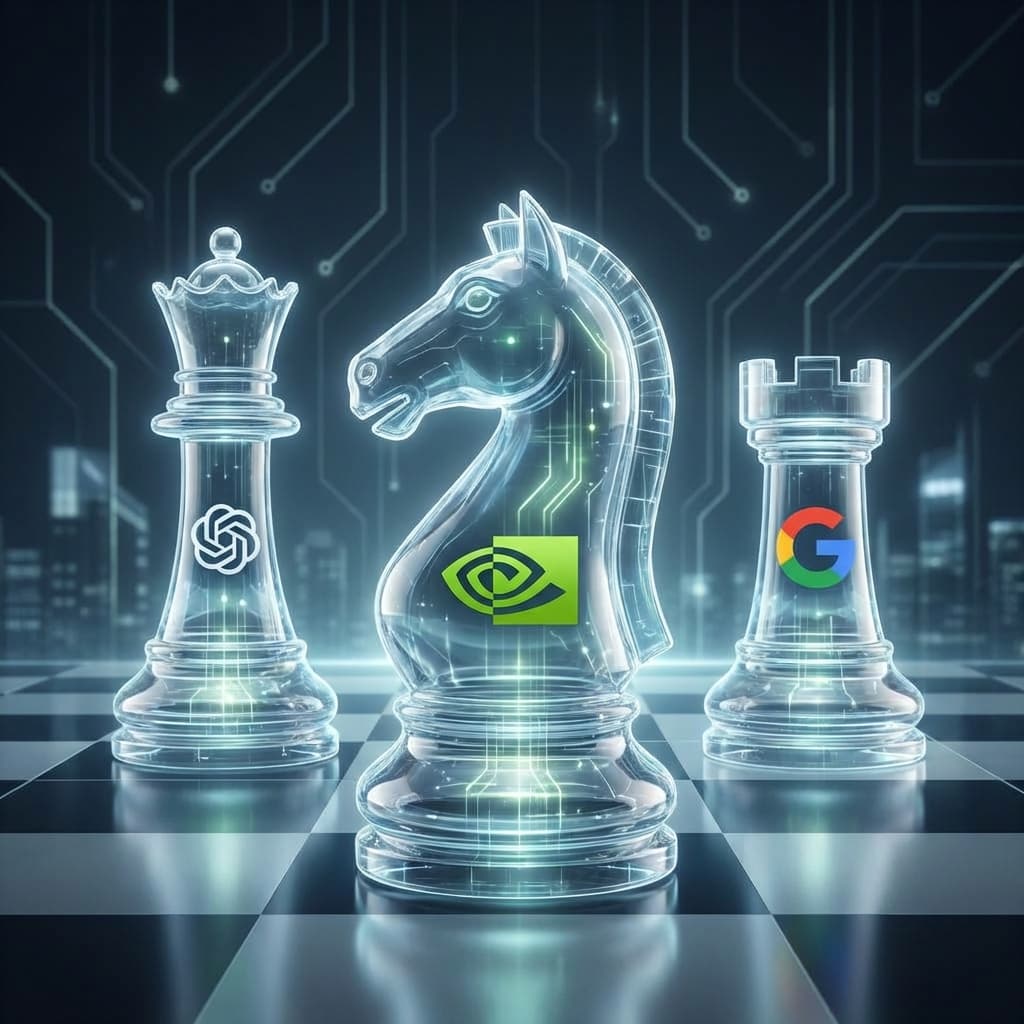
Big Tech companies are entering a phase of surgical moves around AI: licensing agreements instead of direct acquisitions, strong bets on advertising in assistants, and “trust” positioning as a competitive advantage. What is happening in January 2026 are not just isolated news reports; it is a reconfiguration of the battlefield.
Nvidia: Control of the Inference Stack Without Raising Alarms
Nvidia has been synonymous with GPUs and training for years, but its $20 billion deal to license Groq's inference technology shows a more sophisticated strategy: absorbing critical IP and talent without fully buying the company. This move allows it to bolster its AI hardware dominance while mitigating regulatory risks associated with a total acquisition.
Groq provides LPUs and a specialized compiler that make inference faster and more efficient than standard GPUs—something key in a stage where the bottleneck is no longer training, but serving models at scale. By integrating this technology, Nvidia sends a message to enterprise and cloud customers: “with us, you have both the training muscle and the best inference route.”
OpenAI: The (Inevitable) Entrance into Advertising
OpenAI has confirmed that it will begin testing ads inside ChatGPT, introducing a monetization model based on impressions for users of the free and Go tiers (the most accessible subscription plan). Brands will be able to buy ad inventory within the conversational experience, with a pay-per-impression (PPM) system instead of the classic pay-per-click.
At a narrative level, OpenAI frames this decision within a set of principles: alignment with the mission, independence from organic responses, conversation privacy, and a focus on long-term value. However, the underlying reality is the massive infrastructure cost: significant losses and a high burn rate are projected, creating pressure to find new sources of monetization.
Google: Gemini as a “No-Ads” Bet (For Now)
In contrast, Google has stated that it has no plans to introduce ads within the Gemini app “at least in the short term,” marking a direct contrast with OpenAI’s advertising strategy. Google executives have denied reports suggesting ads in the chatbot in 2026 and emphasize that, for now, the experience will remain free of integrated ads.
This does not mean Google is giving up on AI-based advertising: the company continues to test ads in experiences like AI Overviews and AI Mode within its search engine. The decision to keep Gemini “clean” is seen as a bet on trust, mass adoption, and differentiation from a competitor that has just embraced an ad-supported model.
Regulators and Agreement Structure
The way Nvidia structures its relationship with Groq—IP licensing and talent acqui-hiring—illustrates a broader trend: major AI players are opting for deals that avoid severe antitrust responses. Instead of full mergers, we see:
- Exclusive licenses for critical technology.
- Strategic minority investments.
- Hardware priority access alliances.
This environment forces startups and medium-sized companies to read the map carefully: partnering can be a way to scale, but it can also mean depending structurally on a giant of the stack.
What it Means for the Rest of the Ecosystem
For builders, agencies, and B2B SaaS, these moves redefine the rules:
- Strategic Access: Access to compute becomes a first-order competitive advantage.
- AI Neutrality: The way it is monetized impacts the user's perception of "trust."
- Value Niches: The space for independents lies in complex flows and services with a strong human component where the giants do not enter.